Cancellation policies, explained
Why a clear policy protects your time and your income, how the law treats cancellation fees in five markets, and how to set yours up so clients see it and agree before they book.

A makeup artist sells time, and time does not come back. When a bridal client books your Saturday, you stop offering it to anyone else. You buy in shades for their skin, you plan your travel, you turn down the other inquiry that wanted the same morning. If they vanish the night before, the loss is not abstract. It is a whole day of work that can never be resold.
That is the gap a cancellation policy is built to close. It is not about being strict. It is about making one quiet agreement, up front, so the awkward money conversation happens once, in writing, instead of at the worst possible moment.
What a good policy actually does
A cancellation policy is less a rule than a piece of communication. Written well, it does four things at the same time:
It sets expectations before money is on the line
Clients are not trying to hurt you. Most no-shows come from people who genuinely did not realize a held appointment had a cost. A policy spells out the deal so nobody is surprised.
It protects the time you can't get back
A deposit and a notice window turn your calendar into something real. A client who has put money down and read your terms is far less likely to drift, and far more likely to give you the notice that lets you fill the slot.
It makes the hard conversation easy
When a policy is agreed in advance, you never have to argue. You point to the terms the client already accepted, and the conversation is over before it starts.
It signals that you run a business
Clear terms read as professionalism. The artists who protect their time tend to be the ones clients take seriously on price, too.
The three things every policy needs
Wherever you work, a cancellation fee or a kept deposit only holds up when the same three things are true. Keep these in mind and the rest is detail:
- 1It was shown before booking. The client saw the terms before they committed, not buried in a receipt afterwards.
- 2The client agreed. There is a clear, recorded yes. Silence or a link at the bottom of an email is not consent.
- 3The charge is proportionate. The fee reflects your genuine loss, not a punishment. A reasonable deposit or tiered fee is fair. An arbitrary penalty is not.
Hold on to those three. They are the through-line for everything below, because they are roughly what consumer law asks for in every market covered here.
How the law sees it, in five markets
The details differ by country, but the shape is strikingly consistent: be clear, get agreement, and keep your charges fair. Here is the gist in five of the markets makeup artists ask about most.
United States
There is no single federal rule. Cancellation fees live under state contract and consumer-protection law, and they hold up when they were disclosed before booking, agreed to, and tied to a real cost rather than a punishment. Agreeing online is binding, thanks to the federal ESIGN Act and state versions of UETA.
Reference: ESIGN Act; state UETA; state consumer-protection statutes.United Kingdom
The Consumer Rights Act 2015 says your terms must be fair and written in plain language. A cancellation charge has to reflect your genuine loss, not act as a penalty. The usual 14-day online cooling-off right generally does not apply to an appointment booked for a set date, but the fairness test always does.
Reference: Consumer Rights Act 2015; Consumer Contracts Regulations 2013.European Union
The Consumer Rights Directive gives a 14-day withdrawal right for distance bookings, with an exemption for services tied to a specific date. The Unfair Contract Terms Directive means any term that creates a serious imbalance against the client is not binding. In short: state your policy plainly and keep charges proportionate.
Reference: Directive 2011/83/EU; Directive 93/13/EEC; national implementations.Australia
Under the Australian Consumer Law, cancellation terms must be clearly disclosed and must not include unfair contract terms, which now carry real penalties. A reasonable fee that reflects your actual loss is fine. A hidden or excessive one is not. Electronic agreement is valid under the Electronic Transactions Act 1999.
Reference: Australian Consumer Law; Electronic Transactions Act 1999.India
The Indian Contract Act allows reasonable compensation for a cancelled booking, and the Consumer Protection Act 2019 targets one-sided or unfair terms. Keeping a deposit is enforceable when the amount is a fair estimate of your loss and the client agreed to it. The IT Act makes electronic acceptance legally valid.
Reference: Indian Contract Act 1872 (s.74); Consumer Protection Act 2019; IT Act 2000.The common thread
Across all five markets, the same three things decide whether your policy holds: it was shown before booking, the client agreed, and the charge is proportionate to your real loss. Build your policy around those and you are working with the grain of the law, not against it.
A note, not legal advice. This article is general information to help you write a fair policy. Rules change and they vary by region and situation. Before you rely on a specific policy or fee, check your local consumer law or speak to a qualified professional.
Set yours up in MUA Studio
The app is built around those three requirements, so a fair policy is the default rather than something you have to engineer. Here is the whole flow, from your terms to the client's signed yes.
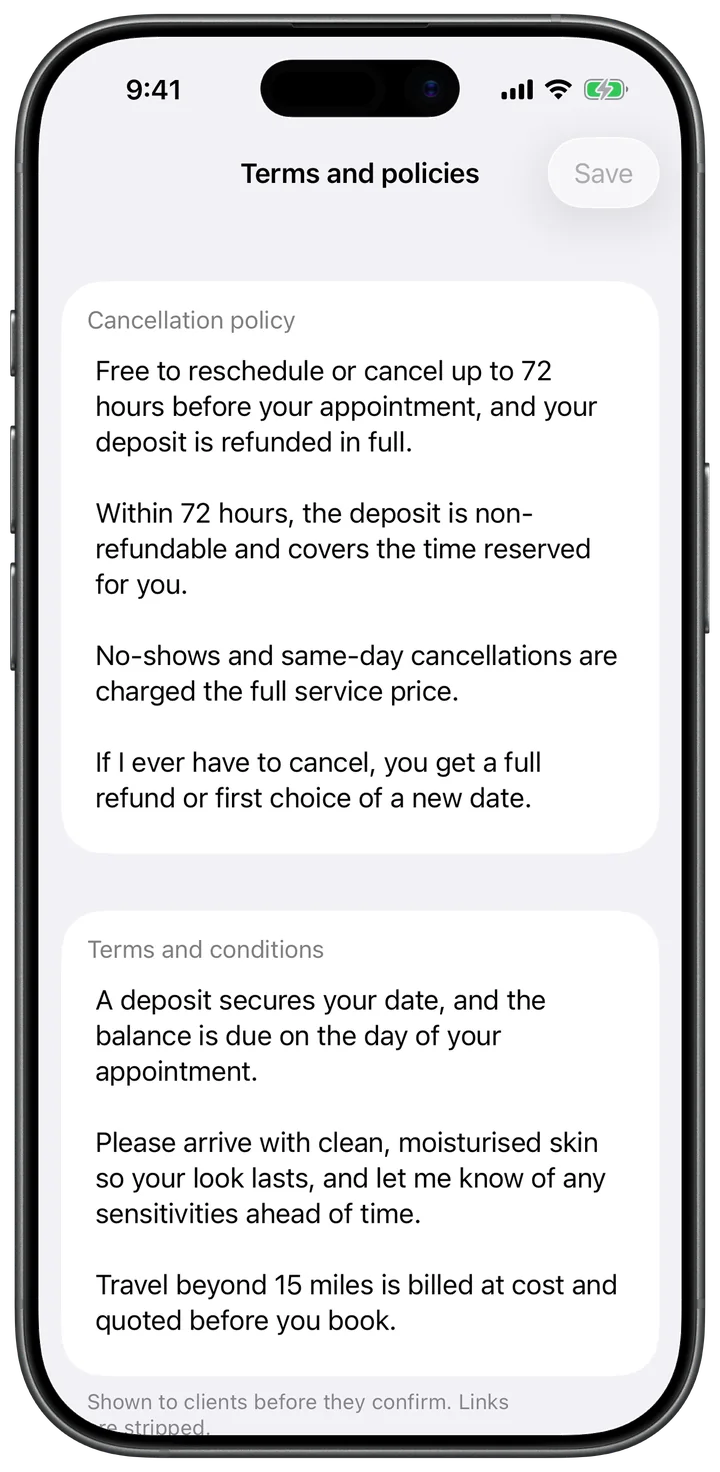
Write it in plain words
Open Settings, go to your booking website, and open Terms and policies. Write your cancellation policy the way you would explain it to a client: notice window, deposit, what happens for a no-show.
- Your words, not legalese, so clients actually read and understand them
- A separate terms field for the rest of the agreement, like balance due and travel
- Links are stripped automatically, so the terms stay clean and safe

Your client sees it and agrees
On your booking page, the policy appears right where it matters: on the review screen, before any money changes hands. The client opens it, reads it, and ticks the box to agree before they can confirm.
- Shown before booking, next to the deposit and the total
- A clear, recorded yes, not a buried link or an assumption
- No agreement, no booking, so consent is never skipped
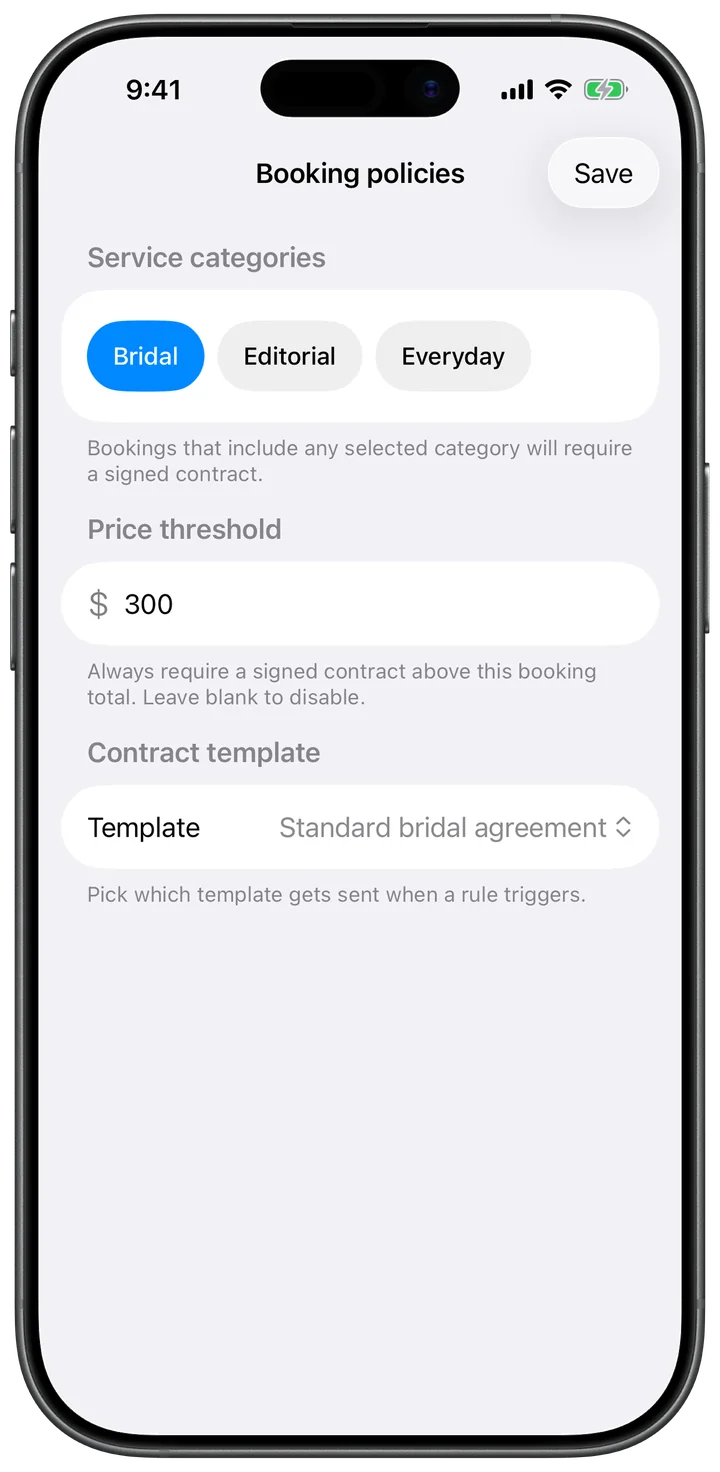
Require a signature on the bookings that matter
For high-value work like bridal, a checkbox may not be enough. Booking policies let you require a signed contract for the bookings that carry the most risk, automatically.
- By category, so every bridal booking always needs a signature
- By price threshold, so anything above a total you set requires a contract
- Your own template is sent for signing the moment a rule triggers
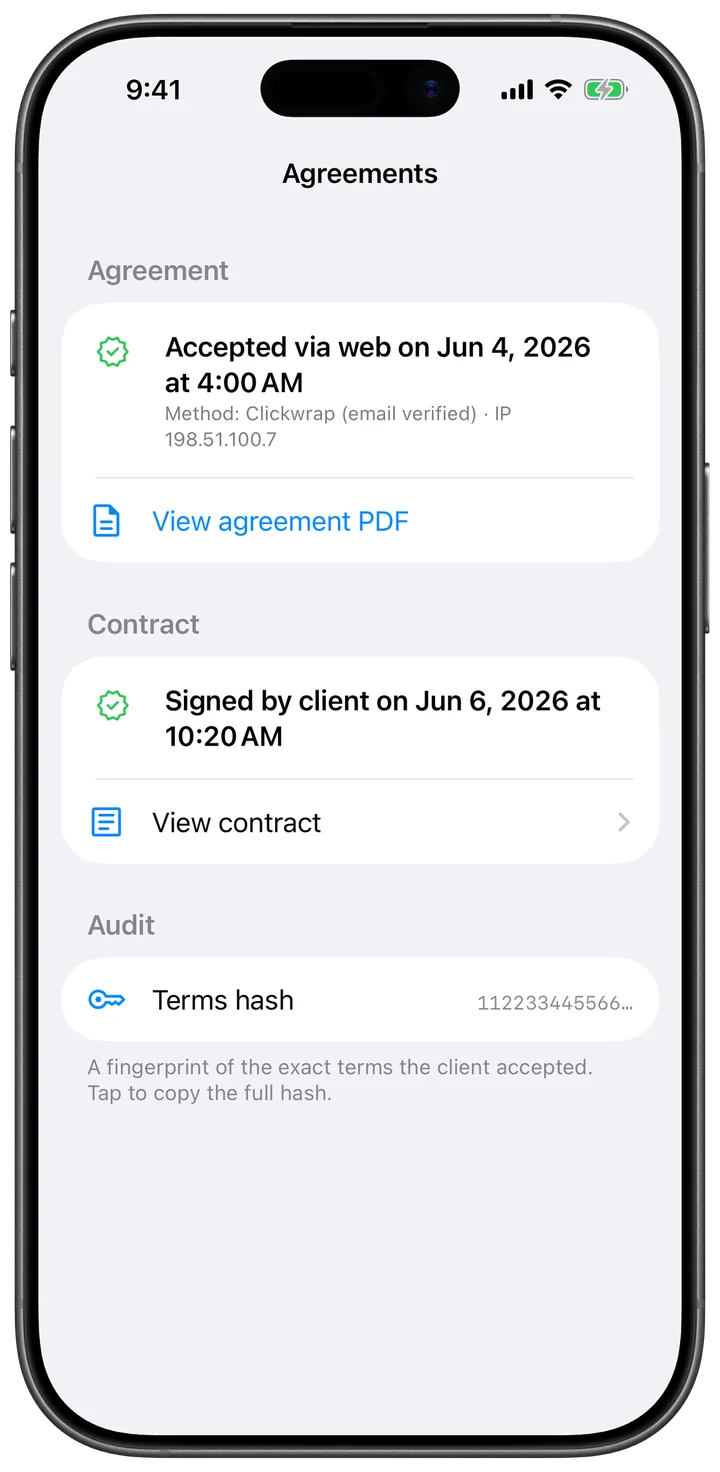
Every yes, on the record
When a client agrees, MUA Studio keeps the evidence so you never have to remember it. Each booking carries a tamper-evident record of exactly what was accepted, and when.
- Date, time, and IP of the acceptance, with the method recorded
- A signed PDF for contracts, saved against the booking
- A terms fingerprint that proves the exact wording the client saw
Built to keep you on the right side of the line
Look back at the three things every policy needs, and the app maps onto them one to one:
- 1Shown before booking. The policy renders on the review screen, before the deposit, so it is never an afterthought.
- 2The client agreed. A booking cannot be confirmed without an explicit, email-verified yes, captured as a timestamped clickwrap record or a signed contract.
- 3Proportionate by design. You set the deposit and the notice window, so the charge stays tied to your real loss instead of a flat penalty.
That record (the date, method, IP, and a fingerprint of the exact terms) is what turns a friendly agreement into something you can stand behind if a booking goes wrong. You set the policy once. The app makes sure it was shown, agreed to, and kept.
Common questions
Do makeup artists really need a cancellation policy?
Yes. A makeup artist sells time, and a no-show or last-minute cancellation is usually a slot you cannot refill. A clear policy sets expectations up front, cuts no-shows, and means the money conversation happens once, in writing, instead of at the worst moment.
Are cancellation fees and non-refundable deposits legal?
In most places, yes, as long as three things are true: the terms were shown before booking, the client agreed to them, and the charge is proportionate to your real loss rather than a punishment. That holds across the US, UK, EU, Australia and India, though the details differ. This is general guidance, not legal advice, so check your local rules.
How much should a cancellation fee or deposit be?
Enough to cover your genuine loss, not more. A common approach is a deposit of around 25 percent to hold the date, a full refund outside a notice window such as 72 hours, and the deposit kept inside it. Keep it reasonable and clearly stated.
Does a client have to agree to the policy for it to count?
Effectively, yes. A recorded, explicit agreement is what makes a policy enforceable. In MUA Studio the client sees the policy on the booking page and ticks to agree before they can confirm, and that consent is saved with a date, time and a fingerprint of the exact terms.